Module 10: Modern & AI Data Systems · Lecture 44 · Week 15
RAG Pipelines & LLM Integration
Retrieval-Augmented Generation: databases as the knowledge backbone for language models
Learning Objectives
- Explain the hallucination problem in LLMs and why retrieval-augmented generation addresses it
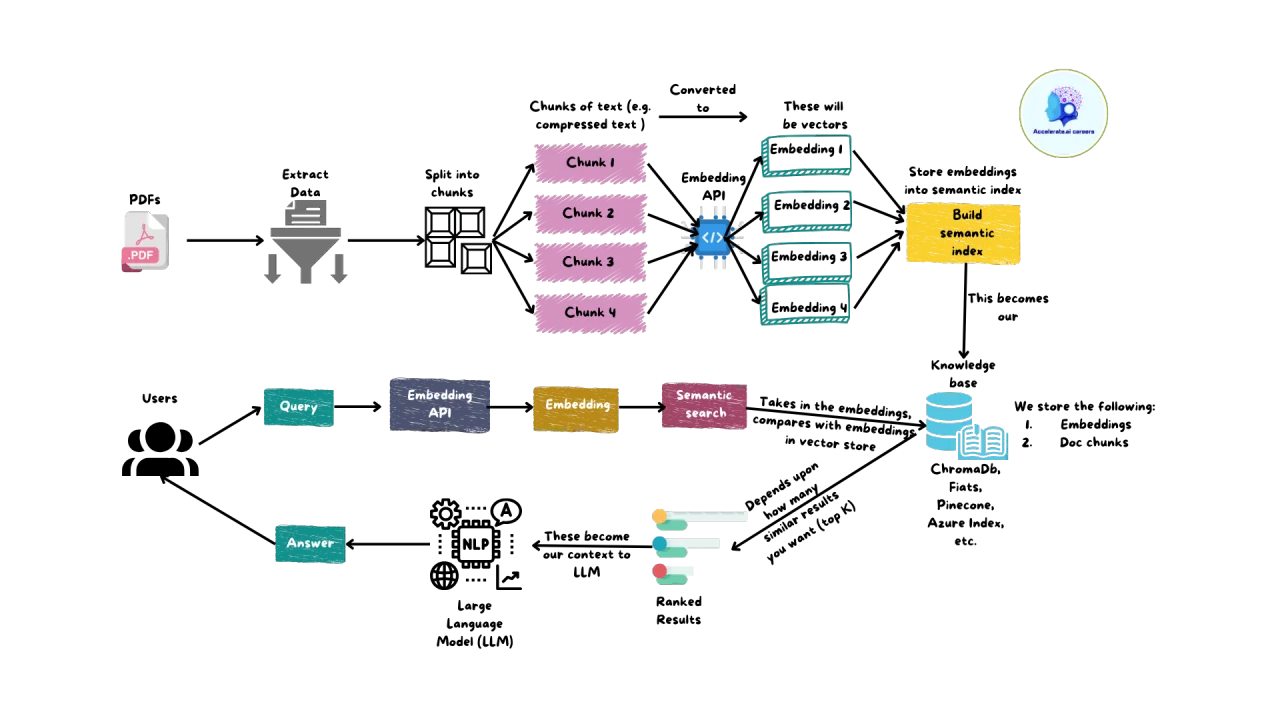
- Describe the two-phase RAG pipeline: offline indexing and online retrieval-generation
- Design a chunking strategy for a given document corpus
- Implement a minimal RAG pipeline using pgvector and the OpenAI API
1. The Hallucination Problem
Large Language Models (LLMs) generate plausible-sounding text by predicting the next token given their training data. They are excellent at reasoning, summarization, and language tasks. However, they carry a well-known weakness: hallucination: generating confident but factually incorrect statements, especially for:
- Events after the training cutoff date (knowledge staleness)
- Proprietary or domain-specific documents the model was not trained on
- Precise quantitative facts (statistics, dates, citations)
- Documents specific to a user's organization (internal reports, product manuals)
Retrieval-Augmented Generation (RAG)
RAG solves hallucination by grounding the LLM in retrieved facts. Instead of asking the model to recall from memory, we:
(1) Retrieve the relevant passages from a database at query time
(2) Inject those passages into the LLM prompt as context
(3) Generate an answer that is grounded in: and citable from: retrieved documents
The database acts as the model's external, up-to-date, domain-specific knowledge store.
2. The RAG Pipeline
Offline (indexing phase: run once or on document update)
Online (inference phase: runs per query)
3. Offline Phase: Indexing
3.1 Chunking
Documents must be split into chunks before embedding. Chunk size is an important design decision: it trades precision against context:
| Chunk Strategy | Size | Pros | Cons |
|---|---|---|---|
| Fixed-size (char) | 200–500 chars | Simple; uniform size | May cut sentences mid-thought; context lost at boundary |
| Fixed-size (token) | 128–512 tokens | Matches embedding model input | Splits at arbitrary points |
| Sentence-based | 1–5 sentences | Semantically coherent units | Variable size; may be too short |
| Paragraph-based | 1 paragraph | Natural document unit | Paragraphs vary widely in length |
| Semantic chunking | Variable | Groups semantically similar sentences | Requires embedding pass on all sentences; expensive |
| Recursive character | Variable | Splits on paragraphs, then sentences, then words | Complex to implement |
Overlap to Preserve Context
When chunking by fixed size, add an overlap of 10–20% between consecutive chunks. A sentence split across two chunks is present in both, so neither loses the context of the boundary sentence. Common choice: chunk_size=512 tokens, overlap=64 tokens.
3.2 Embedding and Storage
4. Online Phase: Retrieval and Generation
4.1 Query Embedding and Retrieval
4.2 Prompt Construction
4.3 Generation
5. Advanced RAG Techniques
5.1 Hybrid Search
Pure vector search can miss keyword-specific queries (e.g., searching for "ARIES" retrieves semantically related documents but may miss the exact algorithm name). Hybrid search combines:
- Dense retrieval: vector similarity (semantic match)
- Sparse retrieval: BM25 / TF-IDF (keyword match)
Scores are fused using Reciprocal Rank Fusion (RRF): rank each result set separately, then sum 1/(k+rank) across both rankers. Documents that appear high in both lists get the highest combined score.
5.2 Re-Ranking
After retrieving top-k candidates, apply a cross-encoder re-ranker (a model that jointly encodes query+passage to produce a relevance score). Cross-encoders are more accurate than bi-encoders (used for initial retrieval) but too slow to run over all documents. Apply only to the top 20–50 retrieved candidates.
5.3 Metadata Filtering
5.4 Parent-Child Chunking
Store small child chunks (for precise retrieval) but return their parent chunk (larger context window) to the LLM. The child chunk's high specificity improves recall; the parent's broader context improves generation quality.
6. RAG vs. Fine-Tuning
| RAG | Fine-Tuning | |
|---|---|---|
| Knowledge update | Add documents to vector store: instant | Retrain model: expensive (hours/days) |
| Cost | Low: vector store + embedding API | High: GPU training time + compute |
| Hallucination | Grounded in retrieved documents | Model may still hallucinate |
| Reasoning style | Keeps base model reasoning; grounded answers | Model adopts new style/behavior |
| Best for | Private documents, frequently changing knowledge | Domain-specific language, tone, formatting |
RAG Failure Modes
Bad chunks: chunks too small lose context; chunks too large dilute relevance signals.
Retrieval miss: the relevant passage is not retrieved (poor recall): increase k or use hybrid search.
Faithfulness failure: the LLM ignores the retrieved context and hallucinates anyway: lower temperature, use strict prompting, check with a faithfulness evaluator.
Irrelevant context: retrieved passages confuse rather than help: improve retrieval quality, add metadata filters, use a re-ranker.
7. The Database Engineer's Role in AI Systems
RAG makes database skills more important, not less, in the age of AI:
- Schema design: modeling documents, metadata, and vector columns correctly
- Index tuning: choosing HNSW vs. IVF, setting M and ef for the recall-latency trade-off
- Hybrid retrieval: combining vector and full-text indexes for best recall
- Data pipelines: building reliable ingestion pipelines that chunk, embed, and upsert documents at scale
- Observability: tracking retrieval latency, recall metrics, and generation quality in production
8. Summary
- LLMs hallucinate on private/recent knowledge: RAG grounds generation in retrieved facts
- Offline phase: chunk documents → embed → store in vector database with ANN index
- Online phase: embed query → ANN search → top-k chunks → inject into LLM prompt
- Chunking strategy (size, overlap) and retrieval quality (k, hybrid search) are the primary RAG quality levers
- pgvector + PostgreSQL enables RAG without a dedicated vector database for moderate scale
- Advanced techniques: hybrid search, cross-encoder re-ranking, parent-child chunking, metadata filtering