Seaweed Lines, Clove Warehouses, and Why Agricultural AI Must Fit Field Workflows
Personal reflections from Zanzibar coastal tidal flats and spice warehouses on why practical agricultural and blue-economy AI begins with human routines, environmental physics, and durable institutions.
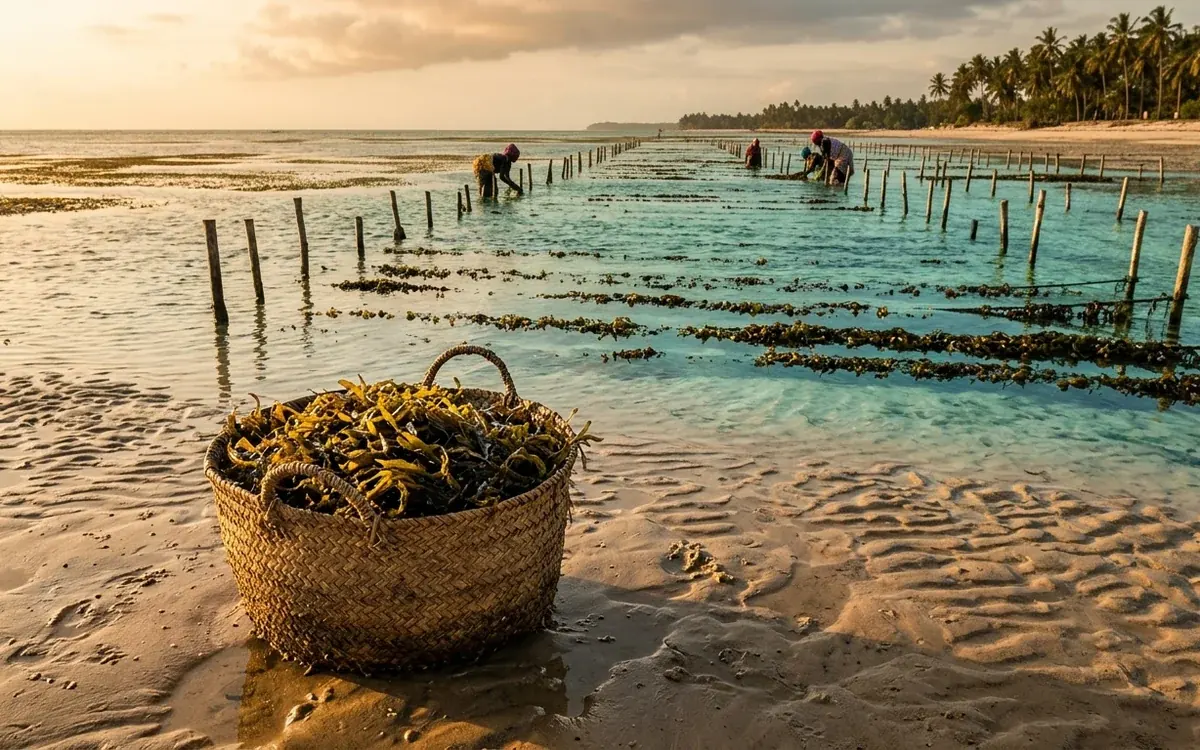
From my office window and along the road south toward Bweleo, Zanzibar reminds any data scientist daily that livelihoods along this coast follow tides, monsoons, and harvest schedules rather than GPU cluster queues. Whether walking out onto coastal tidal flats during spring low tide with seaweed farmers or visiting spice grading floors in Saateni, the gap between tidy laboratory machine learning papers and field reality comes into clear focus.
1. Reading Coastal Waters Along Zanzibar’s Seaweed Flats
Across Unguja and Pemba, thousands of coastal households, predominantly women farmers, tend lines of red algae (Eucheuma and Kappaphycus cultivation) anchored on shallow tidal sands. In recent seasons, warming shallow waters and marine heatwaves have stressed cultivated lines, triggered seasonal “ice-ice” bleaching symptoms, and pushed growers into deeper, harder-to-reach channels.
Building machine learning tools for coastal blue-economy resilience does not start with a generic vision classifier stitched onto satellite previews. Farmers care first about practical questions grounded in ocean physics and household timing: when anomalies in sea-surface temperature and tidal exposure cross heat-stress thresholds around specific bays, how environmental shifts alter expected harvest weight weeks ahead, and whether early alerts reach cooperatives early enough to adjust tying schedules or drying racks. Good environmental modeling stays modest about resolution limits and couples earth observation cleanly with coastal growers’ own tide observations.
2. Lessons Inside Clove Warehouses and Smallholder Cashew Belts
A similar lesson surfaced when working beside Zanzibar State Trading Corporation (ZSTC) clove inspectors at Saateni warehouses (published in ACM AfriCHI 2025 and ETRI Journal 2026). In a quiet warehouse lit unevenly by clerestory windows, inspectors assess moisture, calyx completeness, stem proportion, and dark oil-gland coloration within seconds using practiced touch and sight. Early classifiers trained hastily on single trays produced stunning test percentages simply by memorizing wood-grain reflections and morning shadow angles. Only by listening to inspectors’ physical rules and enforcing two-stage bud-and-stem segmentation did the AI system begin measuring actual clove quality (99.45% macro-F1 across 4,603 ZSTC samples).
We see the same design principle in mainland Tanzania under CashewAI (supported by an IC&SR IIT Madras Exploratory Research Project grant) and across smallholder cassava scouting: models earn trust on dusty paths only when they distinguish anthracnose, gummosis, and red rust across wet and dry phenological stages, run completely offline in milliseconds inside ordinary Android phones (CropGuardNet), and never confuse dark morning soil behind a leaf with pathogen symptoms.
3. Why Most Digital Agriculture Platforms Disappear
In our regional synthesis (Launched, Celebrated, Forgotten), auditing 22 named digital and AI agriculture initiatives across five East African countries between 2009 and 2026 exposed a sobering pattern: only 1 of 22 survived independently after initial pilot press coverage faded. Failures rarely happened because convolutional layers lacked sufficient depth. Tools collapsed when donor grant cycles expired without local revenue, when extension offices lacked maintenance ownership, when farmers had to buy specialized hardware or cellular data packages, or when advisory prompts arrived only in formal English.
Teaching students here in Zanzibar (including Z5007 Programming & Data Structures and Z3003 Data Mining), my goal is to train computer scientists who do not treat datasets as abstract benchmark leaderboards. Every strong research paper or open course module we ship at IIT Madras Zanzibar should honor the same two standards: rigorous quantitative mathematics in the notebook, and honest humility in front of the smallholder farms, spice trays, and coastal tides outside the classroom door. See the full Research Agenda or Swahili overview for active field partnerships.